Far From Betting: Prediction Markets
as the New Financial Primitive
Introduction
Prediction markets have transitioned from a niche forecasting mechanism into a rapidly emerging financial category. What began as an experimental tool has evolved into a system attracting institutional capital from major financial entities, gaining regulatory recognition in the United States, and expanding beyond election-focused use cases into macroeconomic, policy, and technology-driven markets. The financial establishment, once indifferent, is now paying close attention.
Despite this evolution, public perception remains largely anchored to the concept of “betting.” This framing is both inaccurate and limiting, as it obscures the functional role prediction markets play within financial systems. Historically, comparable instruments such as futures and options faced similar skepticism — once characterized as speculative or even prohibited — before becoming integral to institutional risk management. Prediction markets are now undergoing a similar transition, evolving as a hedging tool and a new financial primitive. This report examines that evolution and outlines the implications for their role in modern financial infrastructure.
Co-authors


Key Takeaways
01.
Prediction markets have expanded rapidly, with all-time notional volume exceeding $150 billion and growing 13x within six months, while open interest increased 6x over the past year.
02.
Market activity remains concentrated, with Polymarket and Kalshi accounting for ~79% of total volume, though new entrants are beginning to capture share in specific ecosystems such as Base and BNB Chain.
03.
Total user count has surpassed 2.8 million, with 79.6% concentrated on Polymarket. Kalshi has over 74,000 users, and newer platforms like Jupiter have exceeded 15,000 users within six months of launch.
04.
Market structure is increasingly aligned with traditional exchanges, characterized by CLOB-based trading, exchange-style fee models, and liquidity-driven price discovery. Oracle infrastructure, including Chainlink, enables near-instant, trust-minimized settlement for objective markets, reducing reliance on manual resolution.
05.
As a tool for hedging discrete event risk, prediction markets such as Polymarket and Kalshi outperform traditional benchmarks like polling, futures, and expert forecasts. Polymarket achieves 90.8% accuracy four hours before resolution and 86.2% one month in advance.
06.
Market depth plays a critical role in forecast precision, with high-liquidity markets above $1 million reaching Brier score as low as 0.0247 shortly before resolution, indicating very low probabilistic forecast error.
07.
Despite strong overall accuracy, a consistent pricing bias exists, with outcomes falling short of implied probabilities in 65% of observed cases, indicating modest overpricing.
08.
Institutional adoption is accelerating, with 10% of proprietary trading firms already active, 35% considering entry, and approximately 75% of U.S. firms either participating or evaluating participation, alongside growing integration by hedge funds, insurers, and ETF products.
What Experts Say

Market Overview
As of March 2026, total all-time notional volume across onchain prediction markets has exceeded $150 billion, with Polymarket and Kalshi jointly accounting for 79.02% of activity. Growth accelerated significantly over a short timeframe, with notional volume increasing 13x within six months — from $2.02 billion in August 2025 to a peak of $26.75 billion in January 2026. On a year-over-year basis, volume expanded approximately 28x from 2024 to 2025 and a further 9x from 2025 to 2026, highlighting sustained momentum.
A notable deviation occurred in December 2025, when the BNB Chain-based platform Opinion temporarily surpassed both Polymarket and Kalshi, capturing 34.5% of total notional volume at $6.7 billion.

It is important to distinguish between notional volume and actual trading volume. Notional volume reflects the total face value of contracts transacted, while volume captures the actual capital exchanged between participants. As a result, notional volume can overstate activity, although both metrics generally follow similar directional trends. Peak trading activity was recorded in January 2026, with total volume reaching $12.41 billion and a weekly high of $3.52 billion.
Open interest provides an additional lens into market structure by measuring the total value of outstanding, unsettled positions. Over a one-year period, open interest increased 6x, rising from $192.6 million by end of March 2025 to a peak of $1.08 billion on April 1, 2026. Polymarket and Kalshi remained the dominant platforms, with Kalshi maintaining a marginal lead. Both platforms exhibited a consistent volume-to-open-interest ratio of approximately 34%, suggesting stable liquidity conditions relative to trading activity.
Market activity varies significantly by category. Sports markets account for the largest share of trading volume across both platforms. On Kalshi, sports represented an average of 78.36% of notional volume and 49.8% of open interest between March 2025 and March 2026. On Polymarket, in the same time span, sports accounted for approximately 35% of notional volume but lagged behind politics in open interest, which stood at 12.5%. This divergence reflects differing user behavior: sports markets tend to attract high-frequency, lower-value trades driven by short time horizons, whereas political markets involve longer durations and larger position sizes. Polymarket’s 5 and 15 minute crypto up/down markets have also experienced rapid growth, representing 10% of the platform’s notional volume in recent months with $3.5 billion traded to-date.

The Three Pillars:
How Prediction Markets Work
Prediction markets are structured around a consistent architectural framework composed of a defined outcome, a pricing mechanism, a settlement process, and a verification system. This structure can be conceptualized as a foundational event supported by three core pillars: market mechanism, infrastructure, and resolution. Together, these components determine how efficiently markets generate and settle probabilistic signals, and how prediction markets are fundamentally different from traditional sportsbook betting.

The Base: Prediction Event
At the foundational level, a prediction market contract represents a binary outcome. Each contract settles at $1 if the specified event occurs and $0 otherwise. This binary payoff structure enables direct interpretation of price as probability; for example, a contract trading at $0.62 implies a 62% likelihood. This is opposite to the sportsbook structure, where the house sets the odds for bettors to bet against.
Prediction markets can theoretically take multiple forms, including binary, categorical, and scalar structures. Binary markets present yes/no outcomes (Will the Fed cut rates in September?), categorical markets offer mutually exclusive choices (Which party will win the UK general election?), and scalar markets resolve across a continuous range (What will the US unemployment rate be in Q3?). In practice, most platforms standardize around binary contracts as the primary tradable unit, while grouping multiple contracts into broader event structures when necessary.
For example, both Polymarket and Limitless distinguish between single-market events and multi-market configurations, each contributing differently to overall trading activity. On Polymarket, volume was relatively balanced between the two formats from March 2025 to March 2026, with single-market contracts accounting for 49% of total volume and multi-market structures representing 51%. In contrast, Limitless exhibited a strong preference for single-market formats, which comprised 97.2% of total volume over the same period.
Pillar 1: Market Mechanism
The market mechanism determines how prices update and how liquidity is provided. This is where prediction markets look most like traditional finance — and where their engineering choices most directly affect the quality of the probability signals they produce. Thanks to their open exchange design, prediction markets enable continuous price discovery, with probabilities updating in real time in response to evolving conditions.
While multiple models exist — including automated market makers and scoring-rule-based systems — the central limit order book (CLOB) has emerged as the dominant structure. In this model, participants submit buy and sell orders at specified prices, and trades are executed when matching conditions are met. In recent years, thanks to its superior liquidity efficiency compared to legacy models like AMMs, CLOB has evolved to be the popular market mechanism for onchain decentralized exchanges. Platforms such as Polymarket, Kalshi, and Limitless rely on this framework to ensure that prices reflect real participant demand.
On Polymarket, liquidity — or open interest — has trended upward since mid-2025, reaching $459.6 million in March 2026, approaching previous peak levels of $512.3 million in November 2024. If it continues rising at this rate, it will surpass the 2024 peak in about the second week of April. Bitwise’s 2026 prediction that Polymarket open interest will set a new all-time high in 2026 will be realized before the first half of 2026 ends.
Pillar 2: Infrastructure
Prediction market infrastructure spans a spectrum from fully onchain to fully offchain systems, with hybrid models increasingly becoming the standard. Fully onchain systems maximize transparency and decentralization but face scalability constraints, while offchain systems prioritize efficiency at the cost of trust assumptions.
Hybrid architectures balance these trade-offs by combining offchain order matching with onchain settlement. In this model, user orders are processed offchain and subsequently executed via smart contracts, enabling both performance and verifiability.
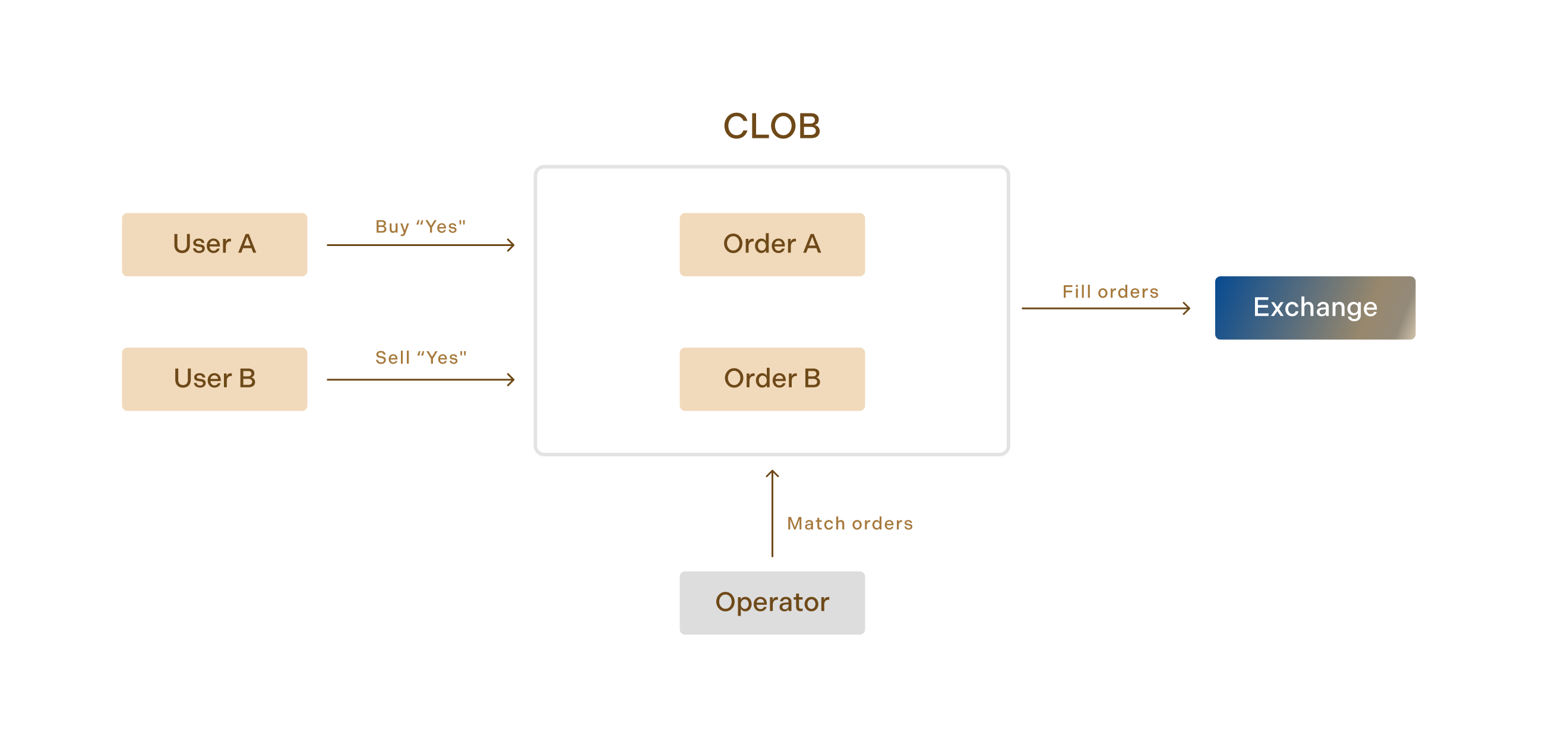
On BNB Chain, transaction share shifted materially in early 2026 following the entry of new platforms. Opinion, which previously held near-total dominance with market share reaching 99.2%, saw its share decline sharply to as low as 6.4% as competitors such as Probable and Predict.fun gained traction. Despite this contraction in transaction count, Opinion continued to lead in average transaction size, maintaining approximately $1,776 per transaction.
Pillar 3: Resolution
Resolution mechanisms determine how outcomes are verified and settled, making them critical to overall system trust. Even highly efficient pricing systems lose credibility if outcomes are resolved inaccurately or inconsistently.
Resolution operates across two layers: governance mechanisms that define truth criteria, and oracle systems that deliver verified data onchain. Centralized governance approaches such as human judgement prioritize speed and simplicity, while decentralized jury models and hybrid systems enhance resistance to manipulation at the cost of complexity.
Oracle infrastructure similarly varies in design. Centralized oracles provide fast data delivery but introduce single points of failure, whereas decentralized networks like Chainlink’s Decentralized Oracle Networks (DONs) aggregate inputs from multiple independent node operators, each with staked economic incentives for accuracy, and delivers cryptographically signed, timestamped price reports that smart contracts can verify onchain without trusting any single source.
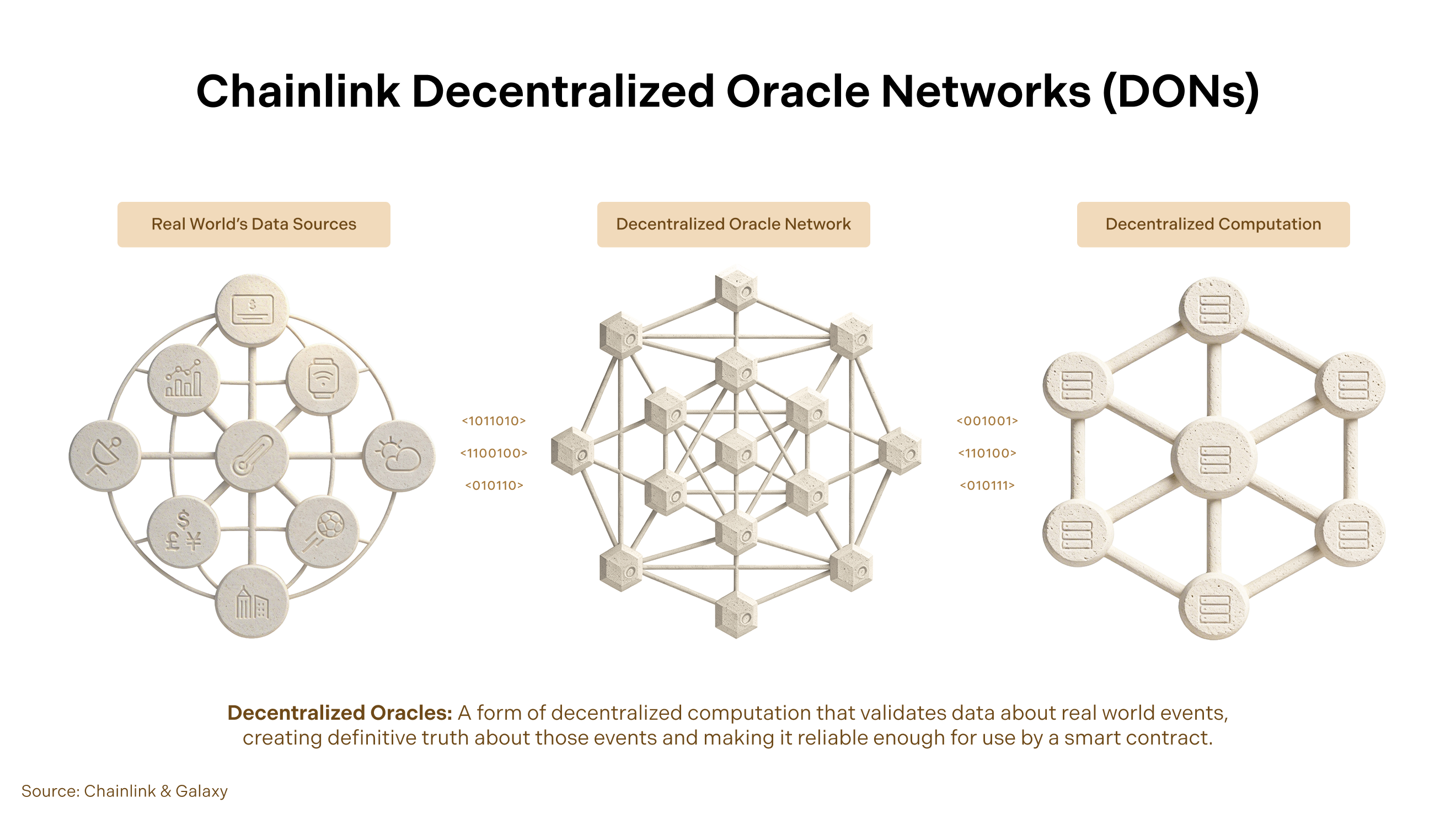
Its October 2025 integration with Polymarket — combining Chainlink Data Streams with Chainlink Runtime Environment (CRE) — enabled near-instant, automated resolution of asset pricing markets on Polygon mainnet, eliminating human delay and dispute risk entirely for objective market types. For markets tied to deterministic asset prices, economic data releases, and quantifiable benchmarks, Chainlink's infrastructure makes trustless, automated settlement possible at scale.
For more subjective markets, Chainlink’s emerging AI oracles can help automate resolution by sourcing and verifying facts across diverse inputs, then using consensus mechanisms to improve transparency and reliability for long-tail, high-context questions.

Prediction Markets as Outcome-based
Financial Instruments
According to the International Accounting Standards, a financial instrument is “any contract that gives rise to a financial asset of one entity and a financial liability or equity instrument of another entity.” Prediction markets satisfy this definition: a contract that defines exactly what each party owes the other depending on the outcome; a financial asset created for one party which is the yes/no share with measurable value at any point in time that can either be sold before resolution or held until maturity; and a financial liability that is collectively collateralized upfront with every yes/no pair backed by $1 of USDC locked in a smart contract.
A hybrid derivative
Given their design, prediction markets are simultaneously similar to options, futures, and bonds. Prediction market contracts often pay $1 (face value) if an event occurs, resembling binary options with a premium paid for contingent payoff and futures through pre-collateralized, binding settlement at a fixed maturity (resolution date). They also borrow bond-like traits with defined payouts, but event-based instead of interest payments.
Due to such hybrid nature, prediction markets defy clean regulatory classification, as evidenced by CFTC struggles. The agency classifies them as unregistered "event contracts" or binary options/swaps under the Commodity Exchange Act, yet their event-driven oracles (e.g., elections) fall outside commodity norms, sparking gaming-vs-derivatives jurisdictional fights that delayed approvals for years, with only limited contracts allowed on platforms like Kalshi. Polymarket's 2022 $1.4 million CFTC fine and U.S. user ban exemplify this, as its crypto peer-to-pool model blurred swaps and gambling lines without DCM registration.
In order to continue operations in the U.S., Polymarket acquired CFTC-licensed exchange QCEX in July 2025. As of March 2026, cumulative notional volume in Polymarket U.S. reached $1.25 billion, with a weekly high of $248.4 million in the last week of March.
Exchange-like fee structure
Kalshi operates under an exchange-based model, charging transaction fees on each trade by taking a percentage of expected returns from both buyers and sellers. Unlike traditional sportsbooks, the platform does not take directional exposure against users, but instead facilitates trade matching between participants. As a result, its revenue is directly linked to trading activity, similar to how traditional exchanges monetize volume.
Polymarket has also introduced an updated fee structure, effective March 30, expanding beyond crypto and sports into additional categories such as finance, politics, economics, culture, weather, and technology. Effective rates vary by market, with crypto reaching up to 1.80%, while most other categories fall within a 0.75% to 1.50% range. Fee levels are highest around the midpoint probability of 50% and decline symmetrically toward both extremes.
Users driving the market
Prediction market accuracy is driven by the same incentive structure underlying financial markets: profit-seeking behavior. Participants who perceive the true probability to be higher than the market price are incentivized to buy, pushing prices upward, while those who assess it as lower are incentivized to sell, driving prices downward. Unlike polling systems, where responses carry no financial consequence, positions in prediction markets are backed by capital at risk. This structure rewards accurate assessments and penalizes mispricing, reinforcing the integrity of price signals.
This incentive alignment has contributed to sustained user growth. As of March 23, total unique users across prediction markets exceeded 2.8 million, with Polymarket accounting for 79.6% of the total. Kalshi recorded over 74,000 cumulative onchain users. Jupiter, a Solana-based application integrating prediction markets, has also experienced rapid adoption, with its user base surpassing 15,000 within six months and continuing to expand steadily.

Prediction Markets as a Hedging Tool
In traditional finance, risk management models are primarily constructed around volatility to estimate asset price movements and inform hedging strategies. Early frameworks such as Black–Scholes assume constant volatility and continuous price evolution, while more advanced models incorporate discontinuities and sudden market shocks. Despite these improvements, the modeling of discrete, binary event risk remains constrained. Existing approaches typically rely on historical data, limiting their forward-looking capability, or infer event probabilities indirectly through market proxies, introducing noise and inefficiency.
Prediction markets address this limitation by directly pricing event probabilities in real time. The resulting outputs provide clear, continuously updated probability estimates that can be integrated into existing risk models without additional transformation.
Accurate discrete event probabilities
Empirical evidence supports the accuracy of these signals. Research conducted by Federal Reserve economists finds that Kalshi’s forecasts for the federal funds rate and CPI deliver statistically significant improvements over fed funds futures and professional forecasters, while also providing continuously updated probability distributions rather than static point estimates.
Additional analysis comparing Polymarket data with traditional polling during the 2024 U.S. election highlights similar advantages. Polymarket not only produced more accurate outcome predictions, but also responded more rapidly to major events, including presidential debates, shifts in candidate participation, and other key developments throughout the election cycle. At the state level, its forecasts for most major swing states also outperformed polling data. By mid-October 2024, as open interest in election markets expanded, Polymarket probabilities consistently indicated a Trump victory, while polling data continued to favor Harris.
In fact, Polymarket demonstrates consistently high predictive accuracy, reaching an average of 90.8% four hours prior to market resolution and 86.2% one month in advance. Evaluation through Brier scores further reinforces this performance, with lower scores indicating greater accuracy. Between June 2024 and March 2026, the cumulative Brier score — measured in half-month intervals — exceeded 0.1 only once, in mid-October 2024, before trending downward through 2025 and 2026 to an overall score of 0.0843. This decline reflects a steady improvement in predictive performance over time. The lowest recorded half-month score occurred on the fortnight of January 1, 2025, at 0.0048, indicating exceptionally high forecast precision during that period.
Market depth exhibits a strong correlation with predictive accuracy, as reflected in Brier scores. Lower-liquidity markets — particularly those below $10,000 — tend to record scores around 0.087, whereas markets exceeding $1 million in liquidity achieve significantly lower scores of approximately 0.0247. This indicates very low probabilistic forecast error in higher-liquidity markets.
At the same time, a consistent pricing bias is observed across markets. Analysis conducted 12 hours and 4 hours before resolution shows that outcomes underperform their implied probabilities in 65% of observed intervals, indicating a tendency for market prices to be modestly overstated.
Institutional and enterprise use cases
Institutional engagement with prediction markets has progressed beyond passive observation into active integration. By early 2026, leading hedge funds and quantitative trading firms, including Oldenburg Capital Partners, had incorporated prediction market data directly into risk modeling frameworks. Similarly, Saba Capital has reportedly utilized recession-linked contracts on Polymarket to hedge credit exposures that may lag behind evolving macroeconomic conditions.
Adoption is also expanding into adjacent sectors such as insurance. In February, sports insurance broker Game Point Capital announced a partnership with Kalshi to hedge NBA performance-based bonuses at nearly half the costs of traditional reinsurance markets. Initial transactions executed prior to the announcement illustrate this efficiency, with pricing significantly below comparable over-the-counter rates (6% versus 12-13%). In parallel, Kalshi established a strategic partnership with Tradeweb to embed probabilistic, forward-looking risk signals into trading workflows used by over 3,000 institutional clients, further integrating prediction markets into core financial infrastructure.
Survey data indicates growing interest within the proprietary trading community. A late-2025 study by Acuiti conducted through its Proprietary Trading Expert Network, found that 10% of firms are already active in prediction markets, with an additional 35% evaluating participation. In the United States, adoption is more pronounced, with approximately three-quarters of firms either trading or considering entry compared to 37% in Europe. Forward-looking sentiment is similarly strong: only 6% of respondents indicated that prediction markets would not play a role in the institutional proprietary trading landscape over the next three to five years.
Product innovation is extending access to broader investor segments. In February 2026, Bitwise filed to list exchange-traded funds tracking prediction market outcomes for the 2028 U.S. presidential election and the 2026 midterm elections. These instruments enable exposure to event probabilities without direct participation in prediction market platforms, mirroring the role of crypto ETFs in providing indirect access to digital assets.
Conclusion
Prediction markets are transitioning from experimental forecasting tools into a foundational layer of modern financial infrastructure. Their ability to generate real-time, capital-weighted probabilities introduces a new class of signal — one that directly quantifies discrete event risk in a way traditional models cannot. As market depth, infrastructure, and resolution mechanisms continue to improve, these systems are increasingly capable of producing reliable, high-frequency forecasts across domains ranging from macroeconomics to politics and beyond. What was once dismissed as speculative activity is now demonstrating clear utility in price discovery, risk management, and information aggregation.
At the same time, institutional adoption, regulatory progress, and product innovation are accelerating their integration into broader financial markets. From hedge funds incorporating probabilistic signals into trading strategies to the emergence of exchange-traded products offering indirect exposure, prediction markets are evolving into a distinct financial primitive. As this transition continues, their role is likely to expand — not as a replacement for traditional instruments, but as a complementary system that enhances how markets process information, price uncertainty, and manage risk.
Special thanks
We would like to express our sincere gratitude to partners and friends
who have supported us and provided data so that we can complete this report


Data providers